
Let’s introduce the stars of today: Bregje is a PostDoctoral researcher at ETH and Stef is a systems engineer at Zeiss. Even though they live abroad from their family, and both have exciting but demanding careers, they managed to start their own family and navigate around the associated challenges.
Interviewing them quickly became a reality check for me: while I had prepared questions about the challenges I expected them to face, our conversation shifted toward topics I hadn’t thought of at all. This exactly highlights one of the reasons for this initiative and the value of these conversations: they reveal perspectives beyond our assumptions. So let’s dive in!
Bregje is already a successful PostDoc in my opinion, following an inspiring path. Surprisingly, her journey started with an education as a physiotherapist. When she realized that this was not her dream job, she went on to study and obtain her PhD from the Eindhoven University of Technology. She studies bone-tendon interfaces and has already been awarded a Rubicon grant for a PostDoc at ETH, a Career SEED grant, and multiple awards for her outstanding work and talks. But who is Bregje, outside of these excellent academic achievements? And specifically, how did her life change after starting her own family?
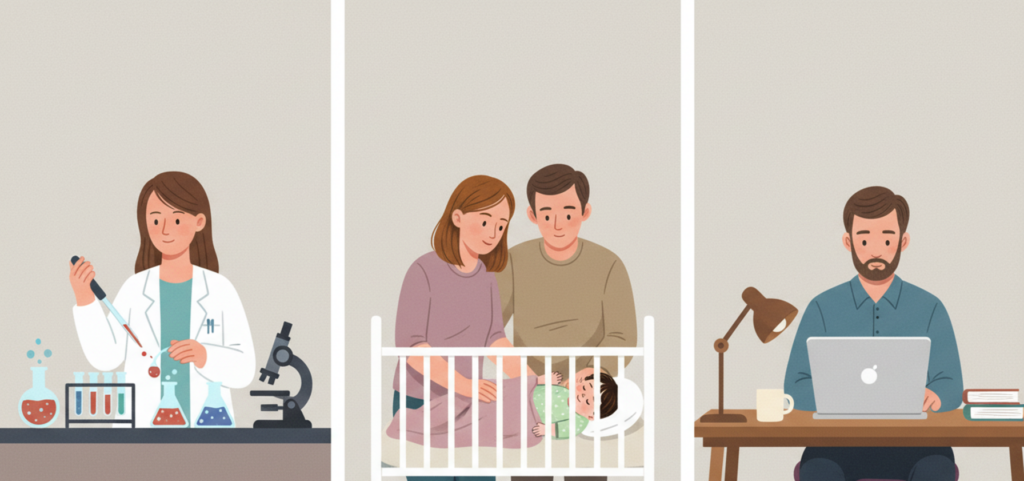
Prioritizing differently!
Starting a family requires you to reassess your priorities, that is probably not news to anyone. But how early that starts and what it means might be an eye opener, at least it was for me. “You really learn to listen to your body, sometimes the hard way…” Bregje tells me.
What was the main eye-opener during pregnancy for you?
“How you really have to take care of yourself. I remember falling asleep during a break at work, there was no way I could stretch myself thin. Pregnancy-brain is a real thing, I couldn’t handle setting up big experiments anymore; it was difficult to process so much information and stay concentrated. You have to accept this is part of the reality now. Luckily, I was surrounded by supportive people, allowing me to take it easy when needed. Complications during pregnancy are unfortunately not uncommon, and expect that at some point you may need to take some sick leave.“
The main takeaway from the questions on this topic was clear: prioritize yourself; no one else can do it for you. But also in our conversations of their short period after returning from maternity leave, Bregje and Stef tell me how their priorities have shifted naturally. While going home on time is a must – the little one has to be picked up from Kita on time – they also really desire to go home at the end of the day. Bregje works 100% and Stef 80%. So on most days, the short hour after work and before the baby goes to bed is extremely precious. You can hear in their answers that they love their child and their work. It is inspiring to see how they consciously make choices to balance the two. So the second takeaway I heard here would be: balance and prioritize the things you love. This is probably the mature version of “work hard – play hard” (with stuffed animals?)?

What sounded like a very positive experience here, is the fact that this new balance went very naturally for Bregje and Stef. Of course, there will be a learning curve, but hearing that this shift was rather effortless might make a difference!
Thinking ahead – a must and desire
This part is probably an issue for all academics. It is standard to have yearly or, at most, 2-year contracts. While fixed positions/longer-term contracts also exist, they are extremely scarce at universities. Considering a pregnancy takes 9 months + maternity leave, you are almost certain that pregnancy and early maternity will overlap with the end of your contract. So how did Bregje approach this?
“When I got pregnant, we knew we had to organize a lot. Many things came at the same time, as we had to leave our apartment in a few months, and my contract would end right around my due date. Furthermore, Stef had just started a new job, so was still in his probation period. So first of all, we rushed into getting a new apartment, which luckily, we managed. In parallel, I had to tell my supervisor relatively early that I was pregnant, as I wanted to discuss the contract with him. We had in mind that if I could get a little more certainty about whether we could stay here, we would stay, but otherwise we would perhaps return to the Netherlands. When I told my supervisor, they indicated they’d be willing to ensure some safety regarding the end date of my contract. This gave us some stability to work with. “

This answer was very revealing to me, as it exactly showcases some problems and solutions. First of all, the uncertainty of 1-year contracts could have determined a complete turnaround of Bregje’s academic career. Emphasizing “could have”, because she overcame this challenge! Second, the leniency of supervisors/PI’s is ab-so-lutely crucial. It not only provided her with a safe space to voice her concerns, but also provided her with certainty about a contract after returning from maternity leave. There may be PI’s that don’t want to do this, or simply don’t have the means to do so.
I have personally always thought of the short contracts as a blessing and a curse. It forces you to think regularly about your career path, making you flexible in getting many experiences in a short time. And projects generally tend to focus on timelines that align with PostDoc durations.
On the other hand, it is of course unfortunate that this results in so much uncertainty. While there are good reasons to question whether the current system is optimal, meaningful change is unlikely in the short term. This does not mean we shouldn’t work on it! Far from it. However, for now, I choose to focus on how to manage and navigate the undeniable uncertainty. For that, here is some last wisdom from Bregje on planning your career around a family:
“An academic career, like having a baby, cannot be perfectly planned. We refused to let the uncertainty of one prevent us from pursuing the other.“
Flexibility – your friend and foe
The last topic is the one that was most surprising/eye-opening to me. Even though somehow I was aware of this, it probably becomes more relevant when you start a family.
“Flexibility is a beautiful and dangerous thing in academia. On the one hand it provides you with the option to manage your own hours, or work from home when necessary. However, it is also expected from you. Academics, like any other people, tend to rush work for deadlines. If you are not able to work more around a deadline (e.g. because you have a sick kid at home), and you have to evaluate something or incorporate feedback, this is sometimes hard to cope with. Setting clear boundaries helps. “
This is something many people will get. Most labs are familiar with late hours around deadlines for abstracts of conferences, grants etc. This can be quite cozy in the offices sometimes, suffering together makes it less worse right ;), but this is not an option anymore if your child needs to come home from childcare.
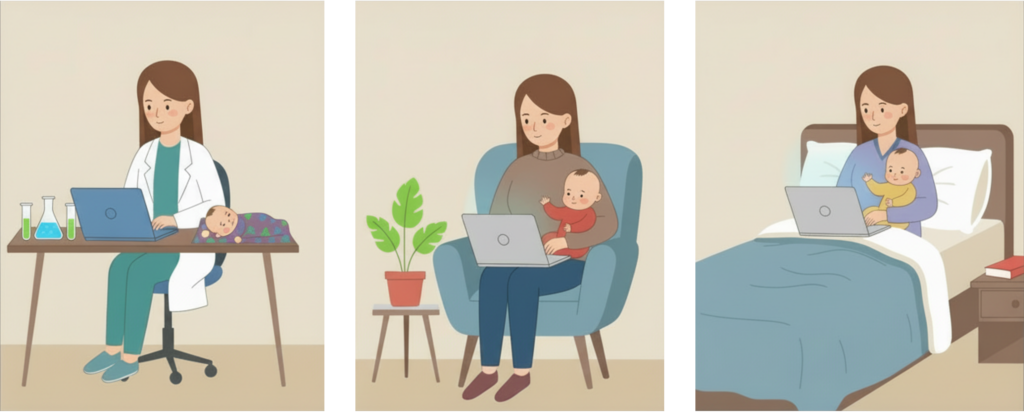
“Another thing is the flexibility of grants. Nowadays, most grants do provide extensions of eligibility criteria for maternity leave. An important experience was that during my pregnancy I got the opportunity to postpone a grant interview with a year, but I needed the funding to secure a job for the next years. So, although funding agencies are generally doing well with accommodating maternity, when you’re on a short-term contract there is often no time to wait for the next round. For me, this means having to prepare grants very well in advance.”
“Despite the challenges, this whole journey has been so rewarding and I learned already so much from it.“
I think from these messages we can derive that the good things flexibility brings you are also challenging in this phase of your career. Setting boundaries can help you if you struggle with coping with differences in flexibility compared to your colleagues. And perhaps the journey will teach us more than we think…
The wrap up
To wrap up this exciting interview, one thing stood out clearly: balance is not something you achieve, but something that continuously shifts. For Bregje and Stef, they clearly kept joy in both their work and family life, when they kept clarity about their priorities and needs. What was reassuring perhaps, is that this new balance in time management came relatively naturally for them. That in itself offers a first glimpse of hope to anyone who feels uncertain about whether it’s possible to combine an academic career with starting a family.
At the same time, they are very realistic about the challenges in job uncertainty. For Bregje, by being transparent about her plans and ambitions, she was able to create more stability and clarity than she initially expected. It didn’t remove uncertainty altogether, but it helped her navigate it with more confidence. And in parallel with that, the support of her supervisor could have affected her career path a lot, and in this case it was a very positive experience, where she was heard and supported.
We also found both benefits and challenges in the flexibility academia offers. Reassessing how you use the flexibility in your academic career helps. By intentionally approaching and working on this flexibility, it can again become what it is meant to be: a way to support professional growth and personal well-being.
Importantly, there is no advice that can be fit-for-all. Everyone has different supervisors, responding differently to your situations. But perhaps, hearing from Bregje’s positive experience may inspire you to do the same!
So who do I want to talk to in the next editions?
Every interview will probably lead to more questions than answers! And this is no exception. For next time in HOW do they do it? What about interviews on:
- A PI about the (in)flexiblity in expenditure of grants. How much flexibility can they provide? Who actually pays if you go on maternity leave?
- Researchers on more industry-partnered grants. Can they manage to get longer contracts through industry partners? Are there people who managed to go to assistant professorships, with non-publicly funded PostDoc awards? Is your workday more like a ‘regular’ researcher in the industry partner, or more like an academic still?
Visual illustrations on this blog were created with the AI image generation tool Recraft. These images are used solely for non-commercial purposes to support the content presented here.